
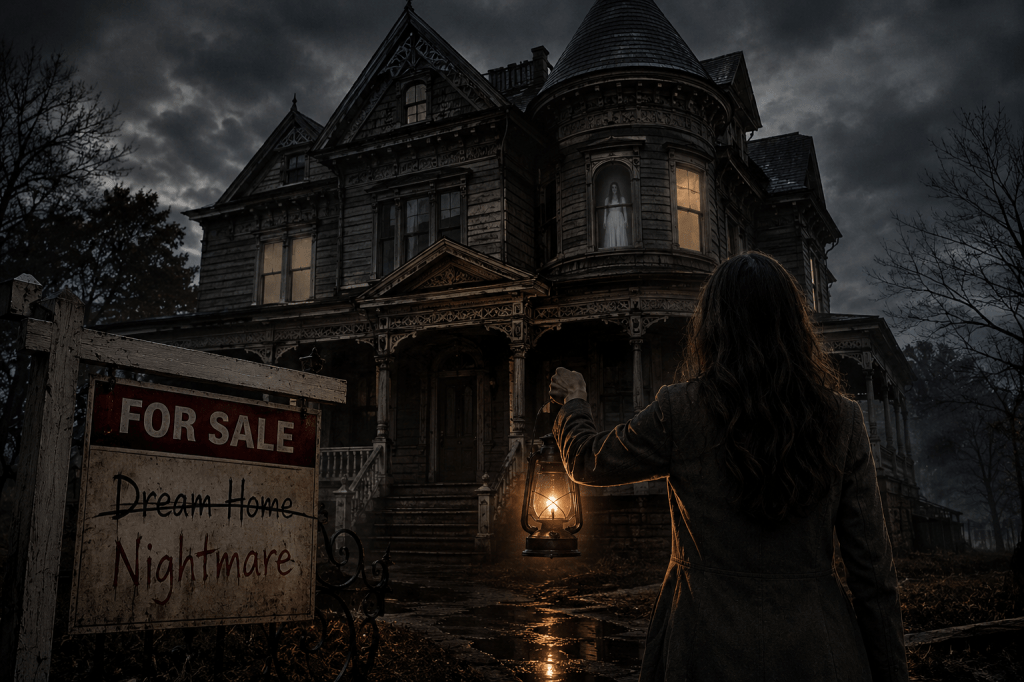
Everyone warned me the house was old enough to have “personality,” but I didn’t think much of it at first.
Let me start at the beginning. A few years ago, I was searching for a new home due to a job change and relocation. After a full day of viewings, I found it—a grand Victorian house. It was larger than I needed, but it fit my budget, and I was instantly captivated. The home, roughly 125 years old, had been beautifully restored to its original elegance. I submitted an offer immediately, and it was accepted almost as quickly.
In hindsight, that should have been a warning sign. But I was already in love with the place and ignored the red flags.
The house stood at the end of the street like something that had outlasted everything around it out of sheer stubbornness. Built over a century ago, the Victorian mansion rose three stories high beneath steep gables and weather-darkened slate shingles. Narrow windows glinted faintly behind curtains yellowed with age. A round turret clung to one corner like a watchtower, its copper roof tarnished green from decades of rain and winter storms.
Even in daylight, the place felt dim.
The wraparound porch sagged slightly under the weight of time. Once-white railings peeled in curling layers, revealing gray wood beneath. Ornate trim—hand-carved flowers, vines, and delicate scrollwork—still framed the eaves, though softened by years of wind and neglect. The front door, a heavy slab of dark oak with stained glass at its center, was marked with countless tiny scratches around the brass handle, as if generations of hesitant hands had reached for it in the dark.
Inside, the house carried the scent all old homes eventually develop: dust, cedar, aged paper, and something faintly damp buried deep within the walls. The ceilings stretched impossibly high, edged with crown molding darkened by age. Every floorboard had its own distinct creak. Pocket doors groaned on their tracks. The radiators hissed awake at odd hours like someone whispering through clenched teeth.
Nothing in the house matched. Wallpaper peeled in layered decades—burgundy florals beneath faded cream stripes beneath pale blue vines. Chandeliers hung slightly crooked in rooms no one used. Mirrors silvered at the edges distorted the hallways after sunset, making them feel longer than they should have been.
At night, the house never truly settled.
Soft knocks echoed through the pipes. Floorboards sighed overhead. Deep within the walls came the occasional sharp crack of old wood shifting in the cold. At times, it didn’t feel like a house aging—it felt like something large breathing in its sleep.
A few nights later, the dreams began.
At first, they were almost beautiful. I saw the house as it might have been in its early days—grand rooms filled with women in corsets and flowing dresses descending the staircase, elegant gatherings in the sitting room. The dreams carried a strange mix of nostalgia and grandeur, but they slowly shifted into something darker.
Then came the screams.
At first only sound—blood-curdling, waking me suddenly in the night. Over time, shadows began to appear—dark, human-shaped figures rushing toward me. And then I saw her: a young woman in a pale blue Victorian dress, blonde curls framing a face no older than twenty. I often saw her at the bottom of the grand staircase, lying in unnatural stillness, filling the dreams with dread I couldn’t explain.
Moving day arrived. The house still needed work, but I decided to renovate gradually while living there. With a new job starting, I didn’t have much choice. I worked room by room, mostly repainting and restoring surfaces.
But strange things began happening.
Items appeared in rooms I hadn’t entered. Doors creaked open and settled on their own. I sometimes heard footsteps behind me—though no one was there. I told myself it was stress, or imagination. I kept working anyway, unaware that the house was becoming something more than just a place I lived.
After nearly three months, most of the renovations were complete, though I was exhausted. One evening, I settled on the couch with the television on. My dog, Luna, slept at my feet.
Then I heard it.
Someone called my name—from another room.
I nearly responded out of instinct, but stopped. I was alone. No one else was home. I listened carefully, but the voice didn’t return. Eventually, I dismissed it and turned back to the TV, uneasy but tired enough to ignore it.
I must have dozed off, because I woke suddenly with a sharp sense of fear.
I looked down—Luna was gone from my feet.
She now stood rigid in the doorway, fur raised along her spine, ears pinned forward. A low growl came from deep in her chest.
“Luna? What is it, girl?” I whispered, standing slowly.
I followed her gaze down the hallway toward the staircase. Nothing was there.
I moved cautiously into the hall and looked up the stairs.
Still nothing.
My heart pounded as I returned to Luna. I stroked her fur gently, trying to calm her—and myself.
“It’s okay,” I whispered, though I didn’t believe it.
I guided her back to the couch. She stayed close, occasionally growling under her breath as she watched the stairs.
Eventually, exhaustion pulled me under again.
And the dream returned—stronger this time.
It was her again.
She is walking barefoot across polished wood that feels too cold to be real…
The mansion is enormous in the way old grief feels enormous—hallways stretching longer than they should, doorways opening into rooms she does not remember passing. Wallpaper blooms in faded florals, but when she looks closer, the pattern shifts: vines twisting into fingers, flowers folding inward like eyes trying not to be seen.
She wears a Victorian-style dress—high collar, tight bodice, sleeves that whisper when she moves. The fabric is pale, almost the color of milk left too long in the light. It drags slightly behind her, as if reluctant to follow.
Somewhere in the house, a clock is ticking wrong. Not steady. Not rhythmic. More like something trying to remember how time works.
She doesn’t know her name at first.
Only that she is looking for something she has already lost.
The air grows heavier as she climbs the staircase. Each step creaks like it is speaking under its breath. Portraits line the walls—stern men and women with eyes that do not quite stay still when she passes. One painting is newer than the rest. It shows her. Wearing the same dress. Standing in the same stairwell.
Except in the painting, her head is slightly turned.
As if she is listening to something behind her.
She stops.
The mansion stops with her.
Then, very softly, the lights in the sconces flicker even though there are no flames—only the suggestion of them, like memories of fire.
A door at the landing opens on its own.
Behind it is her bedroom.
She remembers it now in fragments: lace curtains that never moved with wind, a mirror she was not allowed to look into for long, a bed too large for one person.
The bed is still there.
And it is not empty.
The woman lying on it is her.
Or was her.
Or will be her.
The figure turns its head slowly, and the movement is wrong in a way that makes her stomach drop—too smooth, too patient, like a doll being corrected by invisible hands.
Its eyes open.
They are already aware of her.
“No,” the woman in the bed whispers, though her lips barely move. “You’re late.”
The hallway behind her begins to lengthen again, stretching, folding, reconfiguring itself so the way out is no longer behind her but somewhere deeper inside the house.
The chandelier above her shivers without wind.
And then she understands, with a clarity that feels like falling:
The mansion is not a place she entered.
It is a place that has been waiting to finish her.
I awoke suddenly, sunlight pouring through the large pane windows. Questions flooded my mind: What was that? Who was that? What happened to her? Determined to find answers, I turned to my computer and began searching. I examined previous owners, discovering a surprisingly high turnover rate, with no one residing in the house for more than a year since the early 1900s. My research led me to the original owner and builder of the house, Mr. Nathanial Rose. This discovery deepened my curiosity about the house’s history and its past inhabitants.
Nathanial Rose, a doctor in the early 1800s, constructed this house for his bride, Mary Hansen-Rose. According to the marriage certificate, she was 19, and he was 32, a typical age difference for that era.
My investigation uncovered that Mary was the woman from my nightmares. Her death record listed “unknown causes” at age 22. After her passing, Nathanial remained alone in the house, becoming a recluse. Newspaper articles suggested the townspeople suspected Nathanial of killing his wife, fueling local rumors and suspicion.
My research revealed no death certificate for Nathanial. Did the townspeople find him dead and bury him quietly? Or did they kill him and conceal the truth? These questions fueled my curiosity, intensifying my focus. Suddenly, my stomach growled, reminding me it was time for a break. I stretched, stood up, and surveyed the room. In daylight, everything appeared different—fewer shadows, a lighter atmosphere. I moved past the staircase toward the cozy kitchen. As I pushed open the door and turned on the light, I was startled to face a tall man dressed in old Victorian clothing, his presence adding an eerie twist to the scene.
He appeared the way old photographs fade when they’ve been held too often—edges softened, details refusing to stay still.
The man stands where the light doesn’t quite commit to reaching him.
His coat is dark wool, long and heavy, the kind that once carried the authority of status or profession. A waistcoat sits beneath it, faintly patterned but dulled as if dust has become part of the fabric itself. His collar is stiff, high, and slightly askew, like it was fastened in haste—or never properly undone.
He doesn’t move like a living person. He arrives in positions.
One moment he is gone; the next, he is standing near a doorway that wasn’t open before.
His face is pale in a way that suggests absence rather than complexion. Features are still readable—strong jaw, tired eyes, the faint impression of careful grooming—but everything about him feels unfinished, as though memory is struggling to reconstruct him from fragments.
When he looks at you, it doesn’t feel like eye contact. It feels like being remembered incorrectly.
Sometimes there’s a faint scent around him: old paper, damp wood, extinguished candle smoke. Not unpleasant—just worn down by time.
His presence disturbs the air more than it moves it. Curtains hesitate. Shadows bend slightly toward him, as if recognizing a familiar absence.
And if he tries to speak, the sound never fully forms. Instead, there’s the suggestion of words at the edge of hearing—like a sentence caught in the throat of the world itself, refusing to become sound.
He seems less like someone who died and more like someone who was never allowed to finish living.
I froze upon recognizing Nathanial; I knew it instinctively. Speech failed me, and I stared, mouth agape, struggling to form words my mind couldn’t produce. Goosebumps covered my arms, and I momentarily forgot how to breathe. The man stood still, as if studying me, then suddenly vanished, leaving an unsettling silence behind.
I blinked and exhaled a long sigh, feeling as if I had been released from a spell. I tried to convince myself I was overanalyzing the home and that my imagination was playing tricks, but I knew better. No one would believe my concerns. Feeling uneasy, I decided to continue my research at the local library, seeking clarity and reassurance away from the unsettling thoughts that haunted me.
The library yielded little information, but I learned local legends from elderly residents at the town’s bakery café. One story claims that Nathanial went insane and pushed his wife down the stairs, resulting in her death. Another person believed she died by suicide. When I inquired about Nathanial’s death, no concrete details were provided, leaving the story shrouded in ambiguity and local folklore. Nathanial seemingly vanished without a trace following Mary’s death, never heard from or seen again, leaving his fate uncertain.
Feeling uneasy, I returned home to find my family there. A wave of relief washed over me, reassuring me I was no longer alone in that large house, bringing comfort and a sense of safety.
That night, the nightmare returned—so vivid it felt real. I wasn’t just watching it; I was her again, moving through unfamiliar rooms as if I belonged there. When I came to, I was at the bottom of a staircase, disoriented and unsure of how I got there.
I sat up slowly and looked around. Everything seemed ordinary. Nothing was out of place, nothing to explain what had just happened. But the unease stayed with me, sharp and lingering, as if the experience had left something behind that I couldn’t quite see or name.
That’s when I noticed it—a small door tucked beneath the staircase, one I didn’t remember seeing before. With all the renovations I’d been doing on the house, I couldn’t tell if it had always been there or if I had somehow overlooked it.
Curiosity got the better of me, and I stepped closer to investigate. It was locked. Strange—none of the other doors in the house were. I hesitated, running the thought through my mind. Maybe there was a key for it on the ring the realtor had handed us, the one crowded with old, unfamiliar keys.
I hurried into the kitchen and found the keys hanging on a hook by the back door. Grabbing them, I rushed back to the hallway where the small door waited beneath the stairs—so low and narrow it almost looked like it had been made for a child.
The thought made me hesitate. Maybe I didn’t want to know what was behind it after all.
But curiosity outweighed caution. I couldn’t bring myself to leave it alone, and after a moment’s pause, I kept going.
After trying nearly every key on the ring, exhaustion and frustration were starting to set in—until finally, one slid into the lock and turned.
A rush of hope hit me all at once, my heart quickening in response. With shaky hands, I pushed the old wooden door open, its hinges groaning as it gave way.
A wave of stale air poured out—damp earth, mold, and the musty weight of old newspapers. Inside was pitch black. I reached along the wall just beyond the threshold, searching for a light switch, but found nothing. It must have a pull cord somewhere—though I couldn’t see a thing.
I fumbled in my pockets for my phone and switched on the flashlight, its beam cutting into the darkness ahead.
An empty room.
I lifted my gaze to the ceiling and found a bare bulb with a pull cord dangling from it. I tugged it, and the light flickered alive, swaying slightly as it hung—casting weak, trembling yellow shadows that crawled across the walls.
The space it revealed was barren. A dirt floor. Old brick walls, chipped and worn, stained by years of neglect—or something worse. I stepped inside despite myself, drawn forward by a mix of curiosity and unease. My flashlight swept over the brickwork, and that’s when I saw it: dark red marks embedded in the surface, too deep, too deliberate to be age alone.
A sudden slam echoed behind me.
I spun around. The door was shut.
I rushed to it, gripping the doorknob and twisting hard. Locked.
Panic rose in my throat as I patted my pockets for the keys. Nothing. I dropped to my knees, frantically scanning the dirt floor around me, but there was nothing there. No keys. No sign they had ever fallen.
When I looked back up, my breath caught.
The door was gone.
And in that silence, everything I had ignored came rushing back all at once.
Now I know what happened to Nathaniel Rose.
I just wish I had never opened that door.
 Liz Zemlicka